CodeCap-Bench: Can Code Serve as a Good Video Caption?
Links coming soon.
Abstract
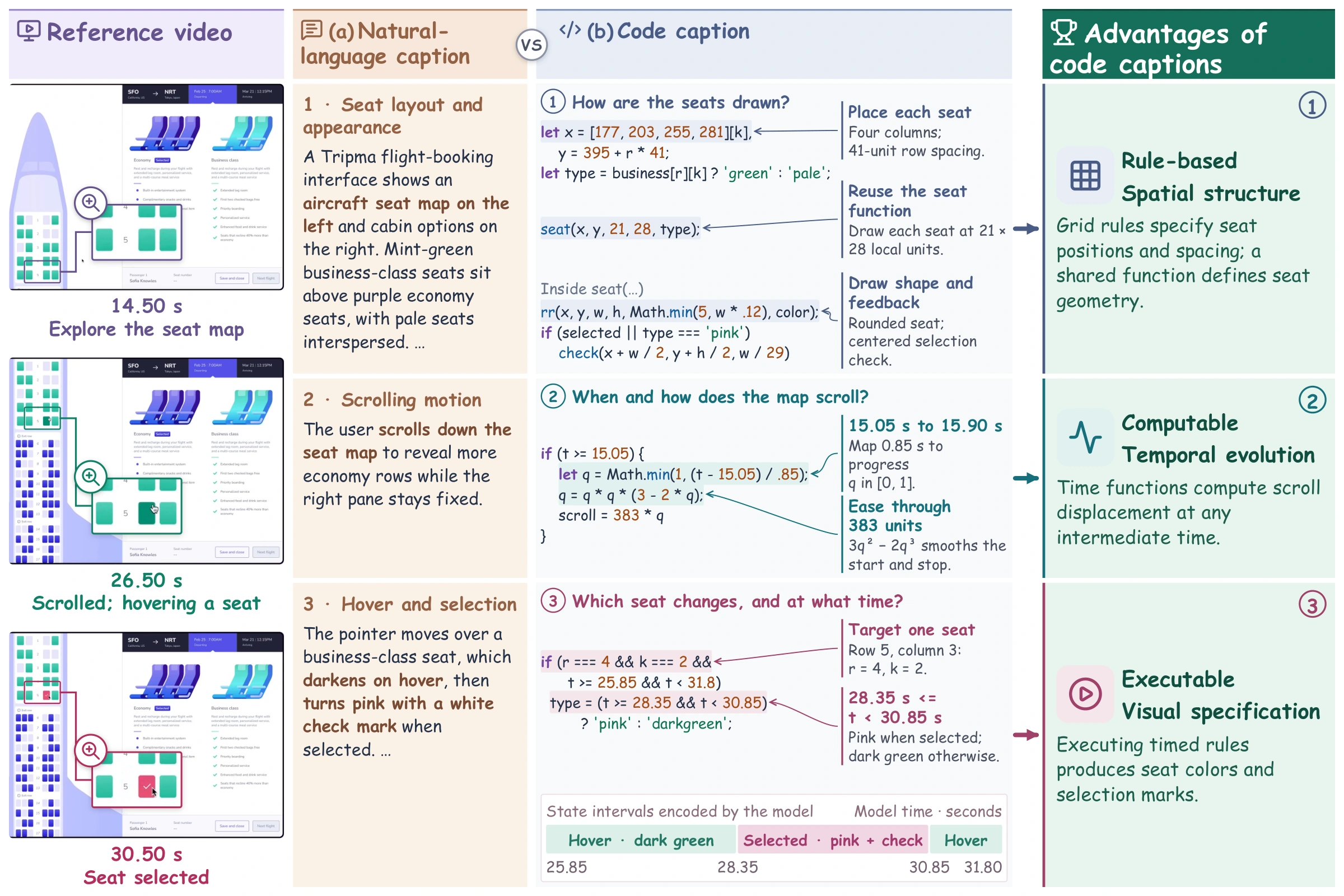
Can executable code serve as a video caption? CodeCap-Bench evaluates this idea on 323 structured 2D videos across five categories. Code captions describe appearance, layout, and motion through graphical primitives and time-dependent rules; rendering makes their fidelity directly assessable. Our experiments reveal substantial differences across models, with dynamic information consistently less faithfully preserved than static content. Under the evaluated settings, code captions also retain more question-answering information and reconstruct videos more faithfully than the tested natural language pipelines.
Benchmark Construction
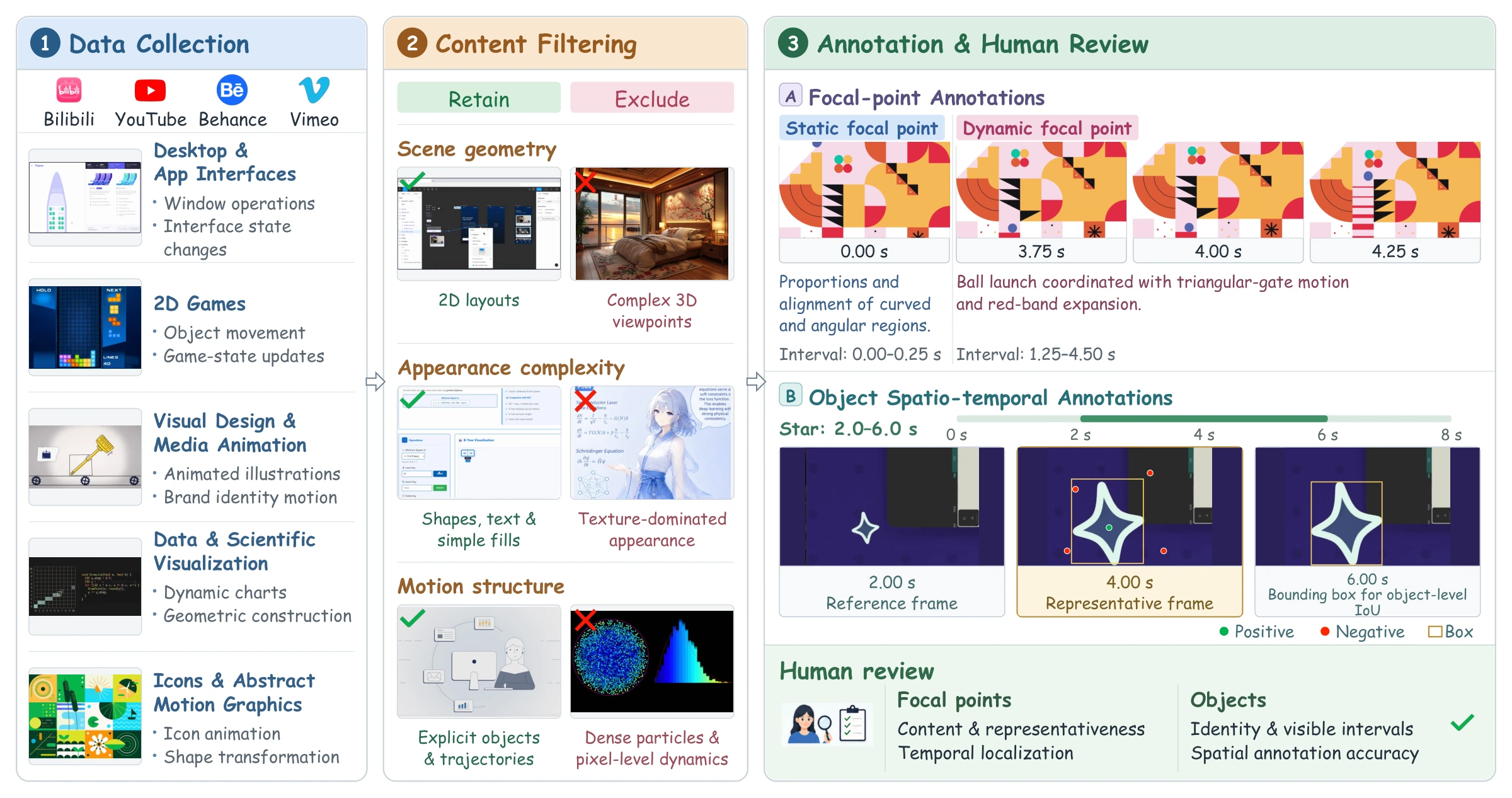
Five categories cover apps, 2D games, visual design, scientific visualization, and abstract motion graphics. Each video includes static and dynamic focal points and object spatio-temporal annotations, checked through human review.
Dataset Statistics
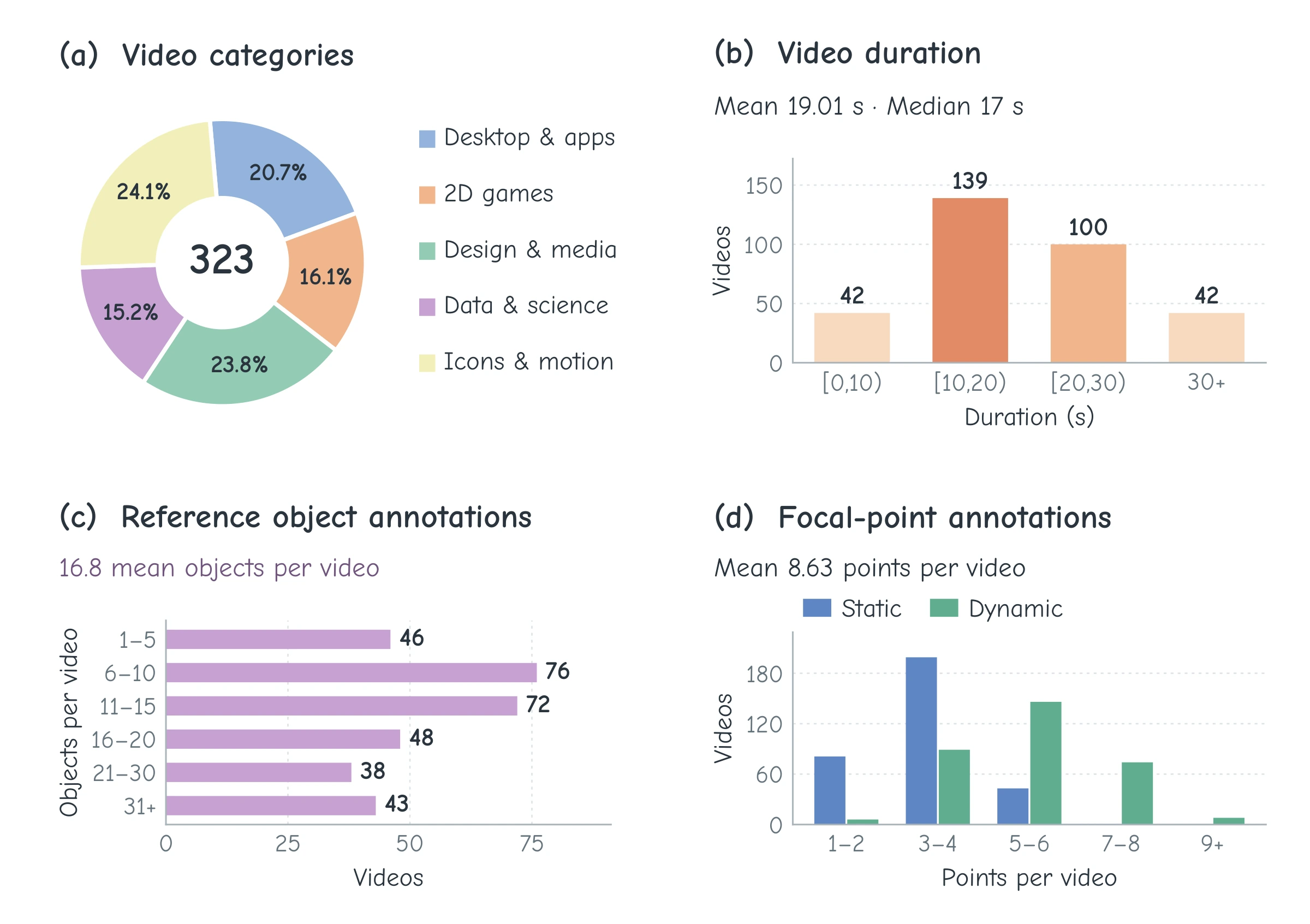
The benchmark contains 323 videos, with a mean duration of 19.01 seconds, an average of 16.8 annotated reference objects, and 8.63 focal points per video.
Evaluation
Rendered code captions are compared with the reference video at three levels. Visual content is generated programmatically, without reference imagery or external visual assets.
- Visual similarity
- Video feature cosine similarity measures overall visual consistency.
- Object-level spatio-temporal IoU
- Checks whether key objects appear at the correct locations and times.
- Fine-grained visual information retention
- Scores static appearance and layout, and dynamic motion, state changes, and timing.
Main Results
Complete results at medium thinking effort. Agentic models use tools and rendering feedback; non-agentic models generate code in one pass.
| Model | Harness | Video success (%) ↑ |
Visual similarity ↑ |
Spatio-temporal IoU ↑ |
Fine-grained visual retention | ||
|---|---|---|---|---|---|---|---|
| Dynamic ↑ | Static ↑ | Overall ↑ | |||||
| Agentic | |||||||
| GPT-6-astra | Codex | 99.4 | 0.9735 | 75.37 | 68.61 | 80.72 | 73.24 |
| GPT-6-astra | Pi Agent | 99.7 | 0.9771 | 74.45 | 67.66 | 81.35 | 72.87 |
| Opus-5 | Pi Agent | 97.8 | 0.9449 | 61.45 | 55.49 | 65.10 | 58.84 |
| Opus-5 | Claude Code | 99.4 | 0.9555 | 58.55 | 53.23 | 63.40 | 56.88 |
| GPT-6-sol | Codex | 100.0 | 0.9563 | 55.63 | 43.92 | 64.04 | 51.34 |
| Qwen3.8-max | Pi Agent | 93.2 | 0.8869 | 48.90 | 44.81 | 55.88 | 48.83 |
| Gemini-3.8-flash | Pi Agent | 98.8 | 0.9257 | 42.75 | 43.66 | 55.18 | 47.73 |
| GPT-6-sol | Pi Agent | 99.1 | 0.9423 | 50.42 | 40.33 | 59.88 | 47.53 |
| DeepSeek-v4.1-flash | Pi Agent | 91.6 | 0.8692 | 45.14 | 40.45 | 51.27 | 44.29 |
| GPT-5.6-sol | Pi Agent | 99.1 | 0.9320 | 46.10 | 38.60 | 53.36 | 44.02 |
| GPT-5.6-sol | Codex | 99.7 | 0.9336 | 42.90 | 37.67 | 51.85 | 42.98 |
| Non-agentic | |||||||
| GPT-6-astra | - | 98.5 | 0.9622 | 69.96 | 69.00 | 76.85 | 72.00 |
| GPT-6-sol | - | 95.7 | 0.9168 | 58.01 | 48.54 | 61.07 | 53.08 |
| GPT-5.6-sol | - | 96.9 | 0.9223 | 49.88 | 46.50 | 56.03 | 50.05 |
| Gemini-3.8-flash | - | 97.2 | 0.9026 | 35.56 | 43.35 | 49.68 | 45.57 |
| Qwen3.8-max | - | 82.0 | 0.7754 | 42.41 | 43.39 | 47.15 | 44.67 |
IoU and retention use a 0–100 scale. Bold marks the highest value in each column within each group. Tasks that fail to produce a video receive 0 on the fidelity metrics. On small screens, scroll the table horizontally.
73.24 overall retentionGPT-6-astra + Codex leads the agentic group, with 75.37 spatio-temporal IoU.
Dynamics remain harderDynamic retention is below static retention in every configuration.
Success and fidelity differAgentic generation improves success rates for all paired models; retention gains vary by model.
Results by Video Category
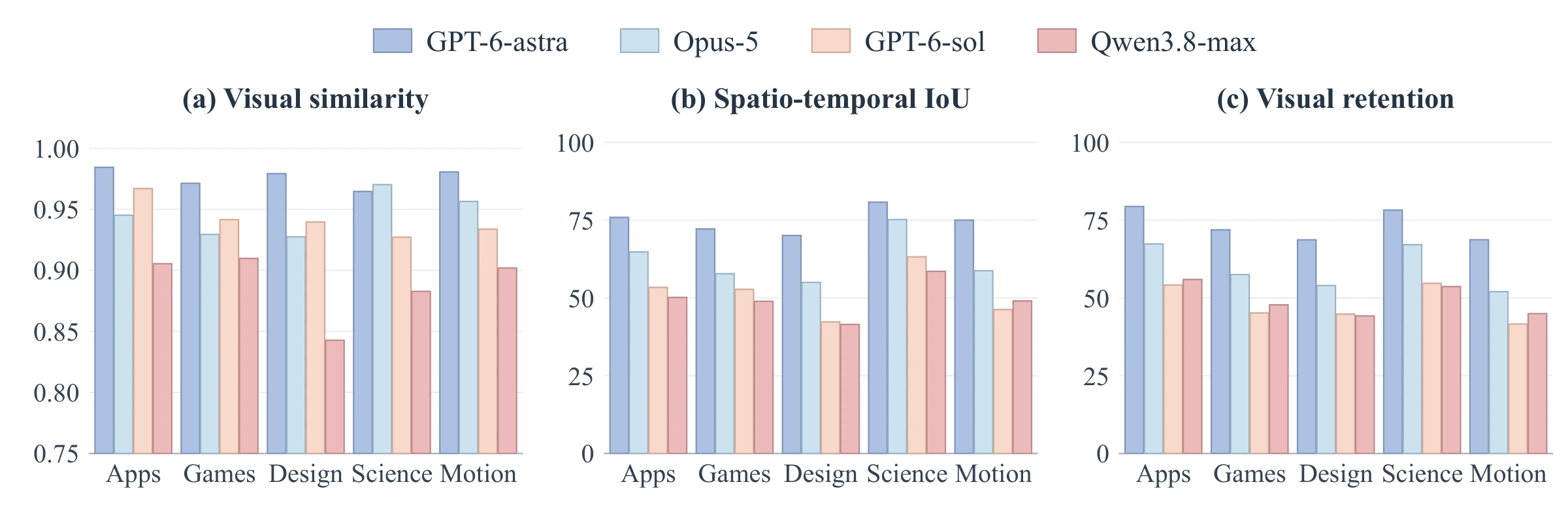
Further Analysis
Thinking Effort
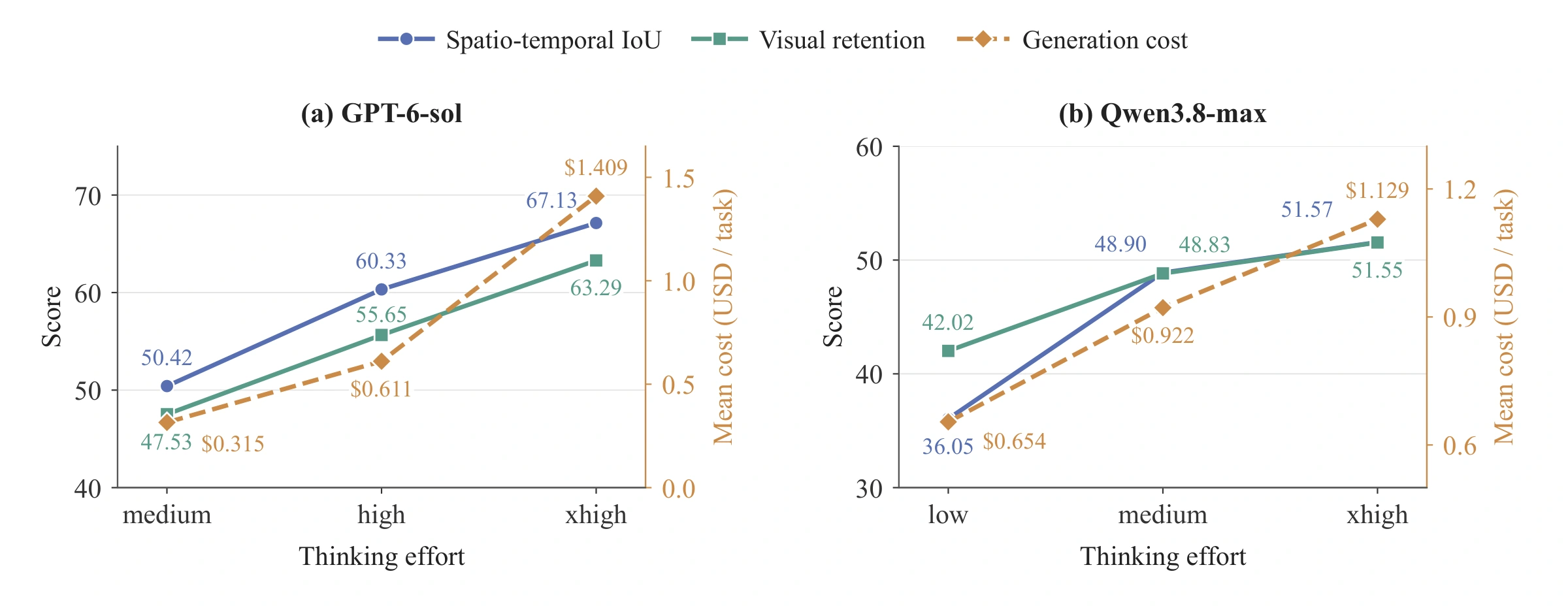
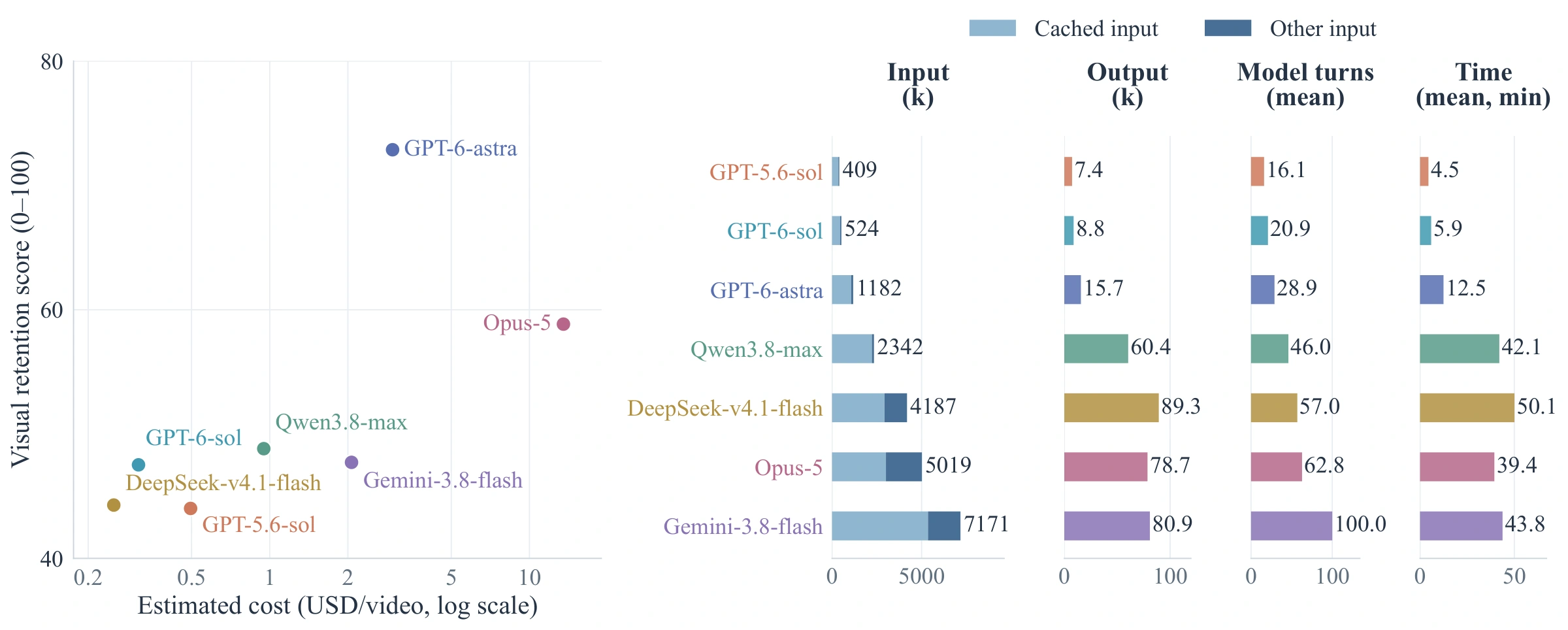
Generation Cost and Efficiency
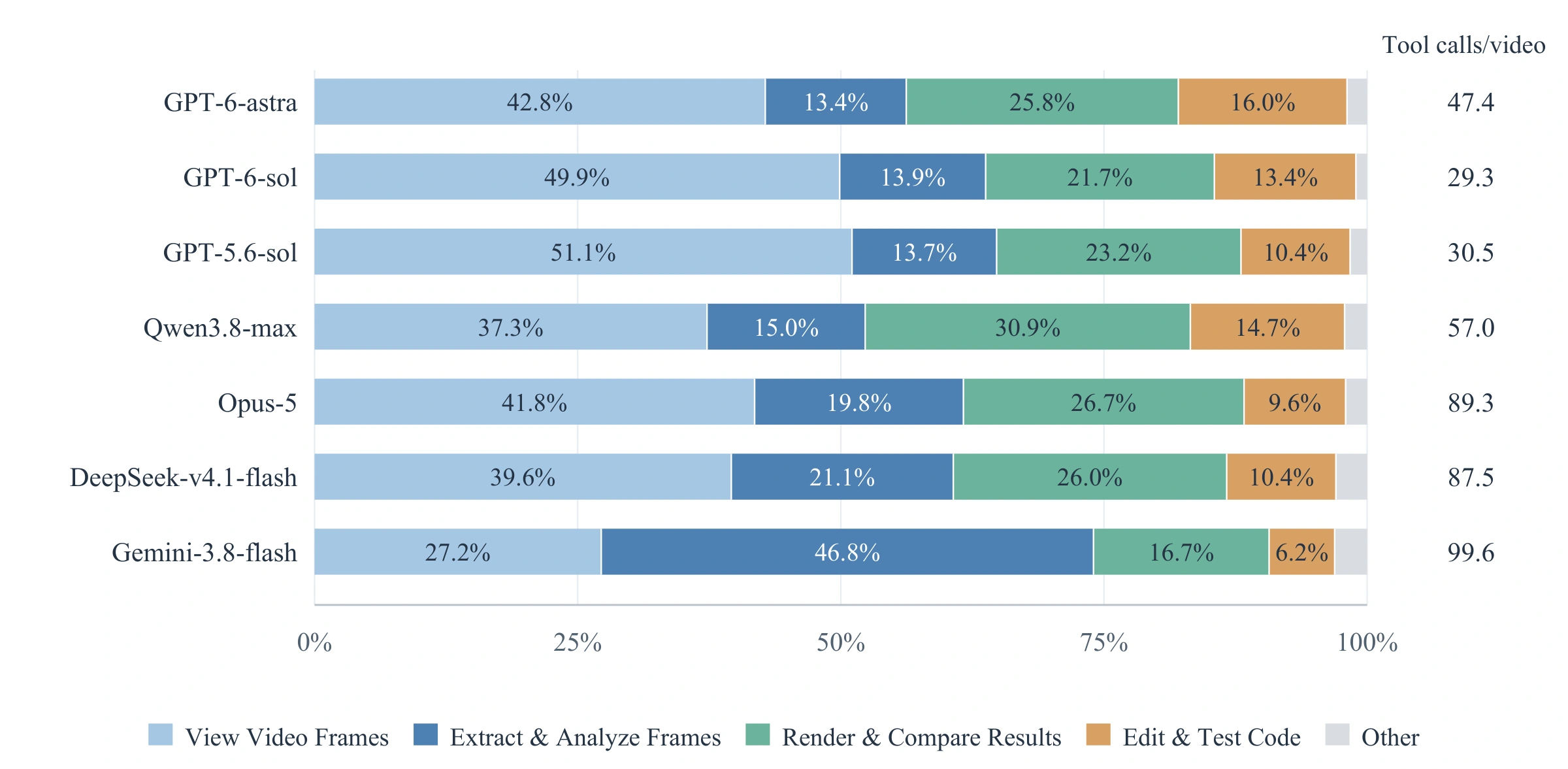
Tool Use
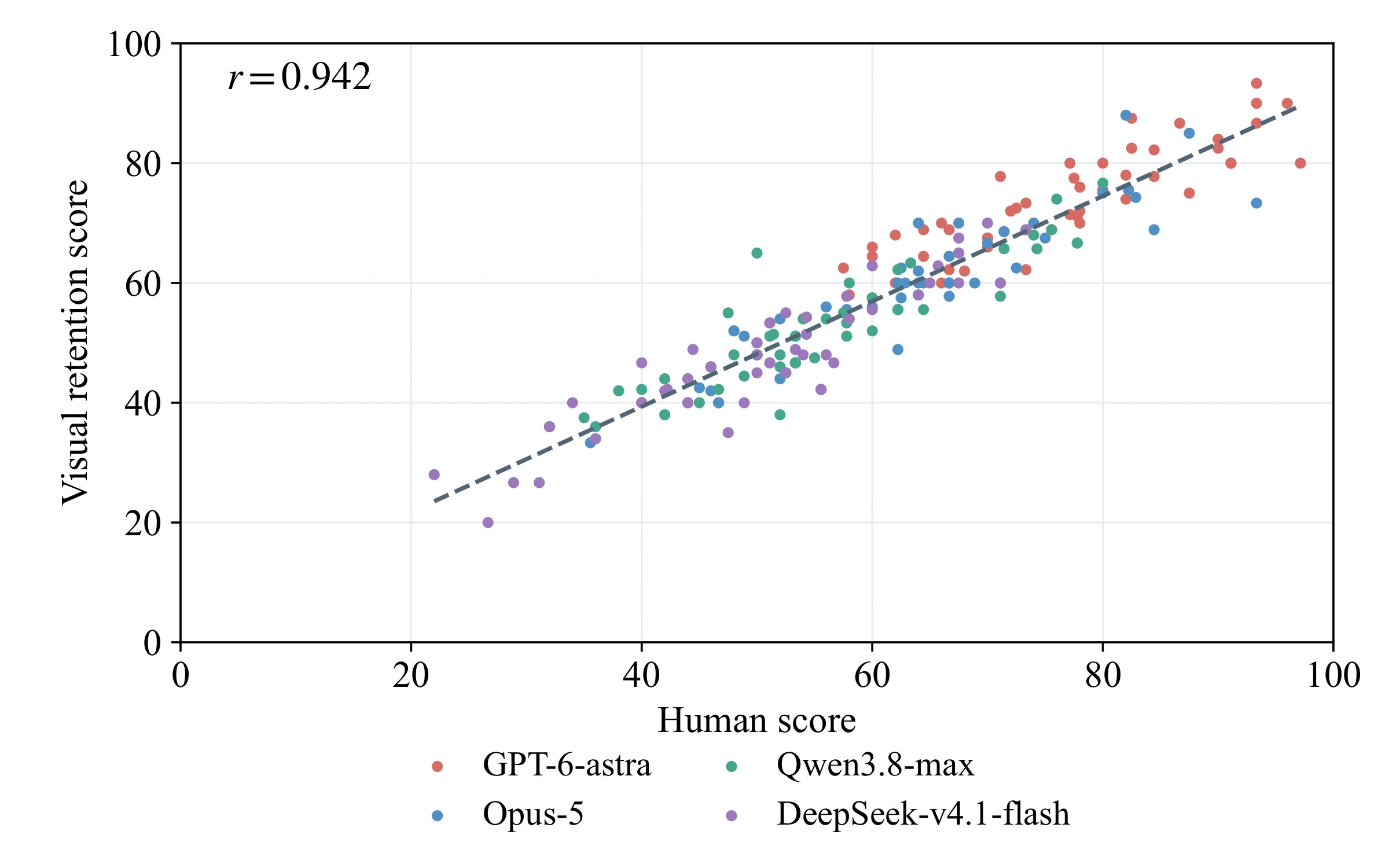
Evaluation Validity
| Generator | Metric | Evaluation model | |
|---|---|---|---|
| GPT-6-sol | Gemini-3.1- pro-preview | ||
| GPT-6-sol | Dynamic | 40.33 | 35.73 |
| Static | 59.88 | 59.55 | |
| Overall | 47.53 | 44.39 | |
| DeepSeek- v4.1-flash | Dynamic | 40.45 | 35.30 |
| Static | 51.27 | 50.18 | |
| Overall | 44.29 | 40.81 | |
Generators: Pi Agent · Medium effort. Both evaluation configurations preserve the overall ranking of these two models.
Code vs. Natural Language
Compare the information retained by code and natural language captions through question answering and video reconstruction.
Question-Answering Accuracy
| Caption generator | Code-rendered video ↑ | Natural language caption ↑ |
|---|---|---|
| GPT-5.6-sol | 76.42 | 73.58 |
| Opus-5 | 83.02 | 72.64 |
| Qwen3.8-max | 81.13 | 78.30 |
| Original video reference | 83.96 | |
Gemini-3.8-flash answers from either the rendered video or the caption text. Code-rendered videos score higher for all three generators; Opus-5 reaches 83.02%, compared with 72.64% for natural language.
Video Reconstruction Fidelity
| Caption generator | Reconstruction path | AS ↑ | MPS ↑ | KSS ↑ |
|---|---|---|---|---|
| GPT-5.6-sol | Code rendering | 0.8907 | 0.5412 | 0.8068 |
| Natural language | 0.6628 | 0.5156 | 0.5925 | |
| Opus-5 | Code rendering | 0.9148 | 0.5572 | 0.8165 |
| Natural language | 0.6932 | 0.5150 | 0.5958 | |
| Qwen3.8-max | Code rendering | 0.8773 | 0.5488 | 0.7817 |
| Natural language | 0.6754 | 0.5185 | 0.5984 |
AS: Appearance Similarity · MPS: Motion Pattern Similarity · KSS: Keyframe Structural Similarity. Bold marks the better path for each model and metric. Code rendering scores higher on all three metrics for each tested generator.
Case Study
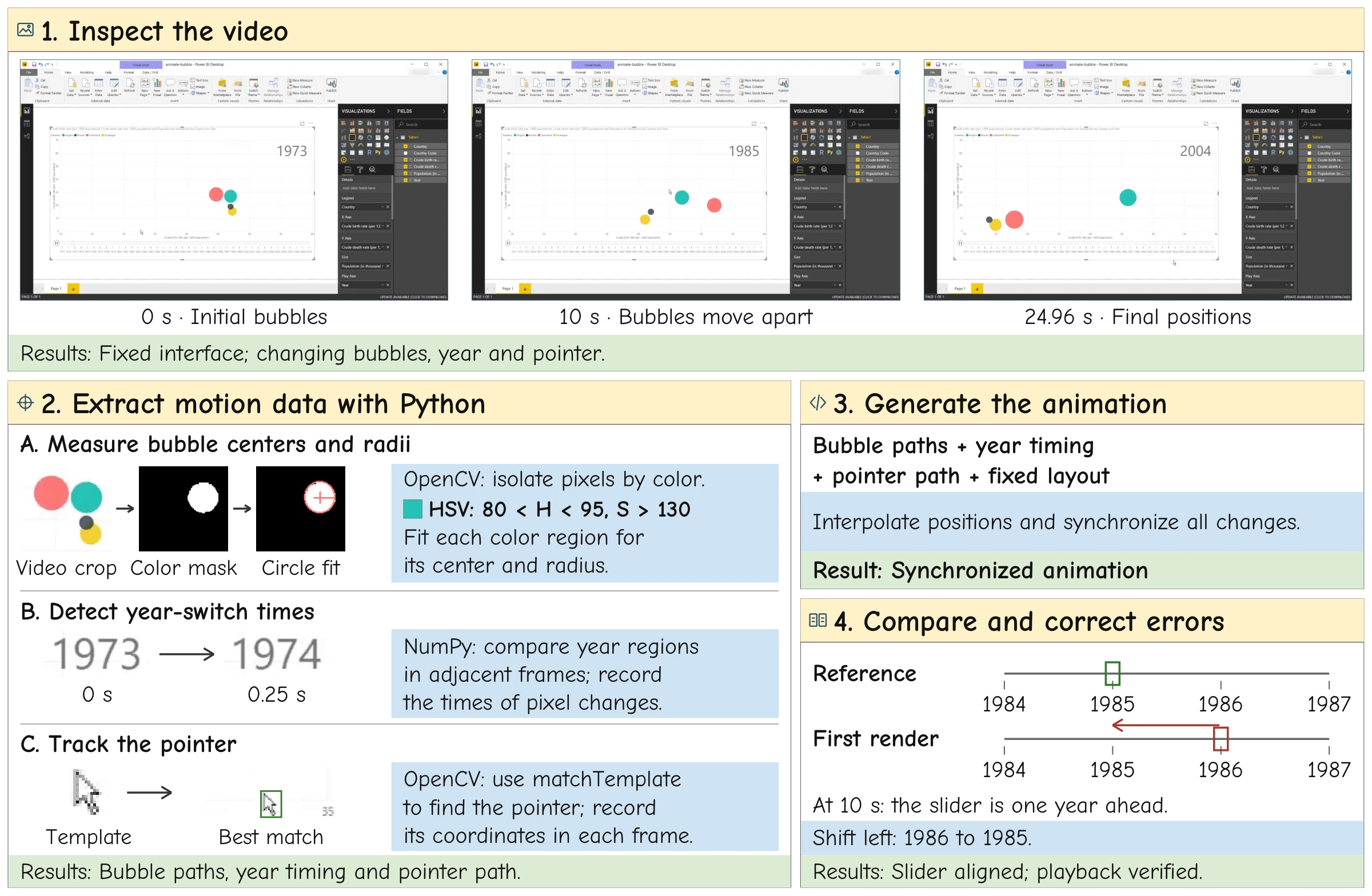
GPT-6-astra + Codex reconstructs a bubble-chart video by measuring object trajectories and timing, then uses rendering feedback to correct a slider that is one year ahead.